

Not all “starlight cameras” deliver real low-light color performance. This guide explains the core hardware and technical specifications behind true starlight night vision surveillance cameras.
Why “Starlight Camera” Has Become One of the Most Misused Terms in Surveillance
Today, almost every security camera brand claims to offer:
✔️ Starlight night vision
✔️ Ultra-low light imaging
✔️ Full-color night monitoring
But after installation, many users still encounter:
❌ Noisy images
❌ Blurry moving objects
❌ Overexposed streetlights
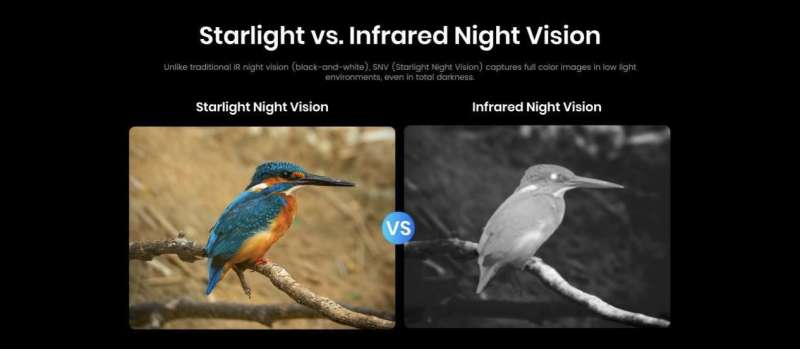
❌ Black-and-white night footage instead of true color
Why?
Because:
True starlight performance depends on hardware, not marketing slogans.
If you really want professional low-light surveillance performance, you must understand the core technologies behind starlight imaging.
🔍 Part 1: The Three Core Hardware Components Behind True Starlight Performance
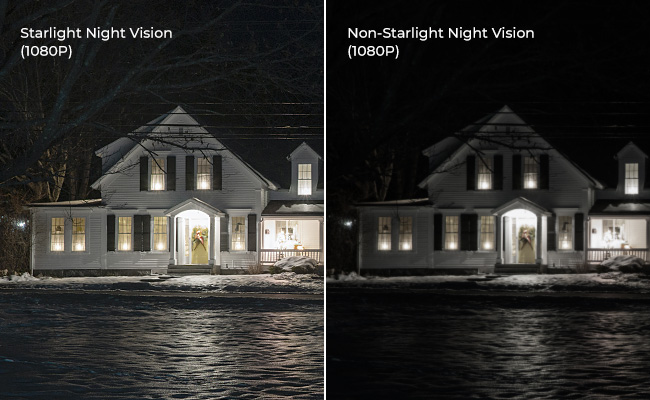
1️⃣ Large Image Sensor: The Foundation of Low-Light Imaging
The image sensor acts like the camera’s:
“Retina”
The larger the sensor size:
👉 The more light it captures.
And in low-light environments:
Light capture is everything.
✅ Key Sensor Specification
A true starlight camera typically uses:
✔️ 1/1.8-inch sensor
or larger.
If a camera claims:
“Starlight Night Vision”
but only uses:
❌ 1/3-inch sensor
then it is likely:
Fake or entry-level starlight marketing.
2️⃣ Large Aperture Lens: The Camera’s “Pupil”
The lens aperture determines:
How much light enters the camera.
Aperture values are marked as:
👉 F-values.
And:
Smaller F-number = Larger aperture = Better night vision.
✅ True Starlight Lens Standard
Professional starlight cameras typically use:
✔️ F1.0 – F1.6 aperture lenses.
If a “starlight” camera uses:
❌ F2.0 or smaller aperture
its low-light performance will be heavily limited.
⚠️ Why Aperture Matters So Much
A larger aperture provides:
✔️ Better color retention at night
✔️ Lower image noise
✔️ Faster exposure
✔️ Reduced motion blur
especially in:
- Streets
- Parking lots
- Warehouses
- Outdoor monitoring scenarios
3️⃣ ISP Processor: The Brain Behind Night Vision
The ISP (Image Signal Processor) acts as:
The camera’s brain.
Even with a good sensor and lens:
❌ Weak ISP processing
can still produce:
- Heavy noise
- Poor color reproduction
- Motion smearing
- Over-sharpened images
✅ What a Powerful ISP Actually Does
A high-performance ISP handles:
✔️ 3D noise reduction
✔️ Color correction
✔️ WDR processing
✔️ Exposure balancing
✔️ Motion optimization
Without strong ISP capability:
True starlight imaging is impossible.
📊 Part 2: The Four Most Important Starlight Camera Specifications
1️⃣ Minimum Illumination (Lux)
This is:
The most critical starlight indicator.
Lux measures:
👉 The minimum light required for visible imaging.
✅ Real Starlight Standard
A true starlight camera should achieve:
✔️ ≤ 0.001 Lux in color mode.
Some premium “Super Starlight” cameras reach:
✔️ 0.0005 Lux or lower.
⚠️ Important Buyer Warning
Some brands measure Lux:
❌ With infrared enabled
❌ Using unrealistic exposure settings
❌ Under laboratory conditions only
Always verify:
Color-mode Lux performance.

2️⃣ Signal-to-Noise Ratio (SNR)
SNR determines:
How clean the night image looks.
Higher SNR means:
✔️ Less image noise
✔️ Cleaner dark areas
✔️ Better detail retention
✅ Recommended SNR Standard
Good starlight cameras should achieve:
✔️ ≥ 50dB SNR.
Premium models often exceed:
✔️ 55dB.
3️⃣ Wide Dynamic Range (WDR)
Night scenes often contain:
- Bright headlights
- Streetlights
- Deep shadows
Without strong WDR:
❌ Faces become black
❌ Bright areas become overexposed
✅ Recommended WDR Standard
True starlight cameras should support:
✔️ ≥ 105dB WDR.
High-end models may achieve:
✔️ 120dB WDR.
4️⃣ Shutter & Exposure Control
In low light:
long exposure improves brightness.
But poor exposure control creates:
❌ Motion blur
❌ Ghosting
❌ Smearing
Professional starlight cameras optimize:
✔️ Slow shutter speed
✔️ Noise reduction
✔️ Motion compensation
to maintain:
Clear moving object capture at night.
🚨 Common Starlight Camera Buying Mistakes
| Myth | Reality |
|---|---|
| Higher megapixels = better night vision | Sensor size matters more |
| More infrared LEDs = stronger night vision | Often causes overexposure |
| All “starlight” cameras are equal | Hardware quality varies dramatically |
| Low Lux alone guarantees quality | ISP & lens matter equally |
💡 The True “Starlight Triangle”
To identify a real starlight camera, focus on this combination:
✅ Large Sensor
(≥1/1.8″)
✅ Large Aperture
(≤F1.6)
✅ Ultra-Low Lux
(≤0.001 Lux)
This is the:
Real starlight imaging foundation.
Why Starlight Cameras Are Growing Fast Globally
Demand for true low-light surveillance is increasing rapidly in:
- Smart cities
- Residential security
- Warehouses
- Farms
- Parking lots
- Industrial facilities
- Construction sites
because users increasingly expect:
✔️ Full-color night monitoring
✔️ AI detection accuracy
✔️ Better incident identification
How SNOSECURE Supports Advanced Night Vision Solutions
At SNOSECURE, we focus on:
✔️ AI-powered starlight cameras
✔️ Full-color night vision systems
✔️ Solar low-power surveillance
✔️ 4G remote monitoring cameras
✔️ OEM & ODM customization
to help global partners deliver better low-light surveillance performance.
Final Thoughts
In the surveillance industry:
“Starlight” is not just a marketing word.
Real starlight performance depends on:
📷 Sensor size
🔍 Lens aperture
🧠 ISP processing
🌙 Low-light optimization
Once you understand these key specifications,
you can avoid fake “starlight” products
and choose cameras that truly perform in real-world night environments.
Contact SNOSECURE
🌐 www.camhiprocam.com
📲 WhatsApp: +86-185-6568-6066
