

What Large-Scale Surveillance Projects Teach Us About Designing Smarter Security Systems
When people watch the FIFA World Cup, they see goals, celebrations, and unforgettable moments.
Security professionals see something entirely different.
They see one of the world’s most sophisticated security operations.
Behind every successful international sporting event is a carefully designed surveillance ecosystem involving thousands of cameras, AI analytics, command centers, access control systems, and emergency response teams working together in real time.
For security integrators, distributors, and surveillance solution providers, the FIFA World Cup offers valuable lessons that can be applied to commercial buildings, smart cities, transportation hubs, industrial parks, and critical infrastructure projects.
Let’s explore the key takeaways.
1. Large Projects Require Layered Surveillance
One camera can never protect an entire venue.
World Cup stadiums typically combine multiple surveillance technologies, including:
- Fixed IP Cameras
- PTZ Cameras
- Thermal Cameras
- AI Cameras
- Perimeter Detection Systems
- Access Control
- Video Management Software (VMS)
Every device has a specific role.
This layered approach creates overlapping coverage and eliminates blind spots.
Lesson for Security Integrators
Design surveillance systems as complete ecosystems rather than individual products.

2. AI Is Now a Standard Requirement
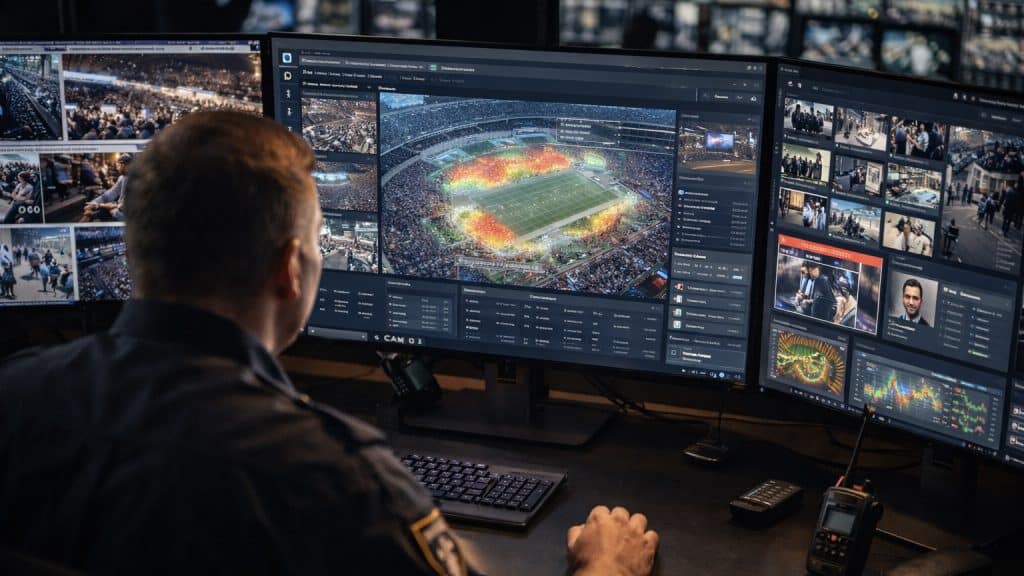
Modern event security no longer depends solely on human operators.
AI helps security teams identify risks much earlier.
Typical AI functions include:
- Human Detection
- Vehicle Recognition
- Crowd Density Analysis
- Intrusion Detection
- Loitering Detection
- Face Recognition (where legally permitted)
- Behavior Analysis
Instead of reviewing hundreds of video streams manually, operators receive intelligent alerts only when necessary.
This dramatically improves operational efficiency.
3. Temporary Projects Need Flexible Deployment
World Cup security extends beyond stadiums.
Temporary monitoring is required for:
- Fan zones
- Parking areas
- Outdoor festivals
- Construction sites
- Training facilities
- VIP entrances
Running power cables to every location isn’t practical.
Solar-powered 4G security cameras provide an ideal solution because they require:
- No power wiring
- No Ethernet cables
- Fast installation
- Remote management
For temporary projects, deployment speed often matters more than infrastructure.

4. Edge Computing Reduces Network Pressure
Thousands of cameras generating continuous video can quickly overwhelm network bandwidth.
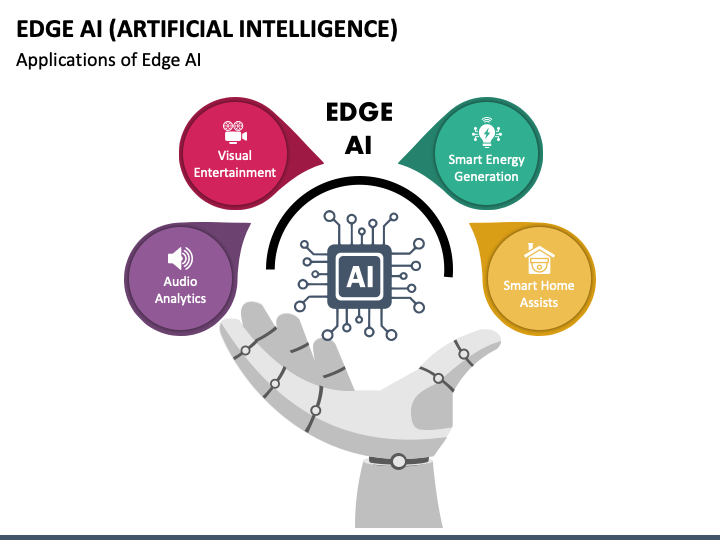
Modern surveillance systems increasingly rely on Edge AI.
Instead of sending every video frame to the cloud, cameras process events locally and transmit only relevant information.
Benefits include:
- Lower bandwidth usage
- Faster response times
- Reduced cloud storage costs
- Better privacy protection
Edge intelligence is becoming a standard feature in professional surveillance projects.
5. Scalability Should Be Built Into Every Design
Large sporting events constantly expand.
Security systems must accommodate:
- Additional cameras
- Temporary checkpoints
- Mobile surveillance units
- New parking areas
- Emergency command centers
The same principle applies to commercial projects.
Choose solutions that can grow without requiring a complete redesign.
6. Reliability Is More Important Than Specifications
The highest resolution camera isn’t always the best choice.
World Cup deployments prioritize:
- System stability
- Reliable power supply
- Network redundancy
- Weather resistance
- Long-term operation
A dependable 4MP AI camera often delivers better project value than an unreliable 8MP model.
Reliability always wins in mission-critical environments.
7. Integrated Security Creates Greater Value
Successful security projects combine multiple technologies:
- Video Surveillance
- AI Analytics
- Access Control
- Alarm Systems
- Video Doorbells
- Solar Power
- Cloud Management
- Mobile Applications
Customers increasingly expect complete security ecosystems instead of standalone hardware.
This creates new opportunities for system integrators to provide value-added solutions.
What This Means for Security Integrators
The FIFA World Cup demonstrates that successful surveillance projects depend on more than camera resolution.
They require:
✅ Smart planning
✅ AI-powered analytics
✅ Flexible deployment
✅ Scalable architecture
✅ Reliable hardware
✅ Integrated management
Whether you’re designing a city surveillance network or protecting a temporary outdoor event, these principles remain the same.
Final Thoughts
The future of surveillance is intelligent, connected, and proactive.
Security integrators who embrace AI, edge computing, wireless deployment, and integrated ecosystems will be better positioned to win larger projects and deliver greater value to customers.
Global events like the FIFA World Cup aren’t just sporting competitions—they’re real-world demonstrations of how modern surveillance technology continues to evolve.
Looking for a Reliable OEM/ODM Surveillance Manufacturing Partner?
At SNOSECURE, we help security brands, distributors, and system integrators build competitive surveillance solutions for projects of every size.
Our product portfolio includes:
- Solar Security Cameras
- 4G LTE Cameras
- WiFi Cameras
- AI Smart Cameras
- PTZ Cameras
- NVR Kits
- Video Doorbells
- Solar Power Systems
With 20 years of manufacturing experience, 6 production lines, and a 12,000 m² factory, we provide complete OEM & ODM services—from hardware customization and logo branding to packaging design and firmware optimization.
Ready to strengthen your next security project?
Whether you’re sourcing products for a stadium, construction site, smart city, or commercial installation, our team is ready to help.
📩 Contact SNOSECURE today to discuss your OEM/ODM surveillance requirements and discover how we can help you build smarter, more competitive security solutions.
Website: www.camhiprocam.com
Email: simple@camhiprocam.com
WhatsApp: +86-185-6568-6066
