

Data Centers, AI and Virtual Power Plants: The Next Solar + Storage Opportunity
How Google’s 2026 Voltus Partnership, Rising AI Electricity Demand, Distributed Battery Storage, and Demand Response Are Creating New Opportunities for Energy Infrastructure
Energy Industry Insights | November 2026 | SNOSECURE
What happens when artificial intelligence needs electricity faster than utilities can build new power infrastructure?
This is becoming one of the most important questions facing data center developers, grid operators, renewable energy companies, and energy storage investors.
Artificial intelligence is accelerating demand for computing infrastructure. New data centers require substantial electricity capacity, dependable power delivery, cooling systems, and grid connections.
Meanwhile, electricity grids must accommodate growing demand from transportation, industrial electrification, air conditioning, and other sectors.
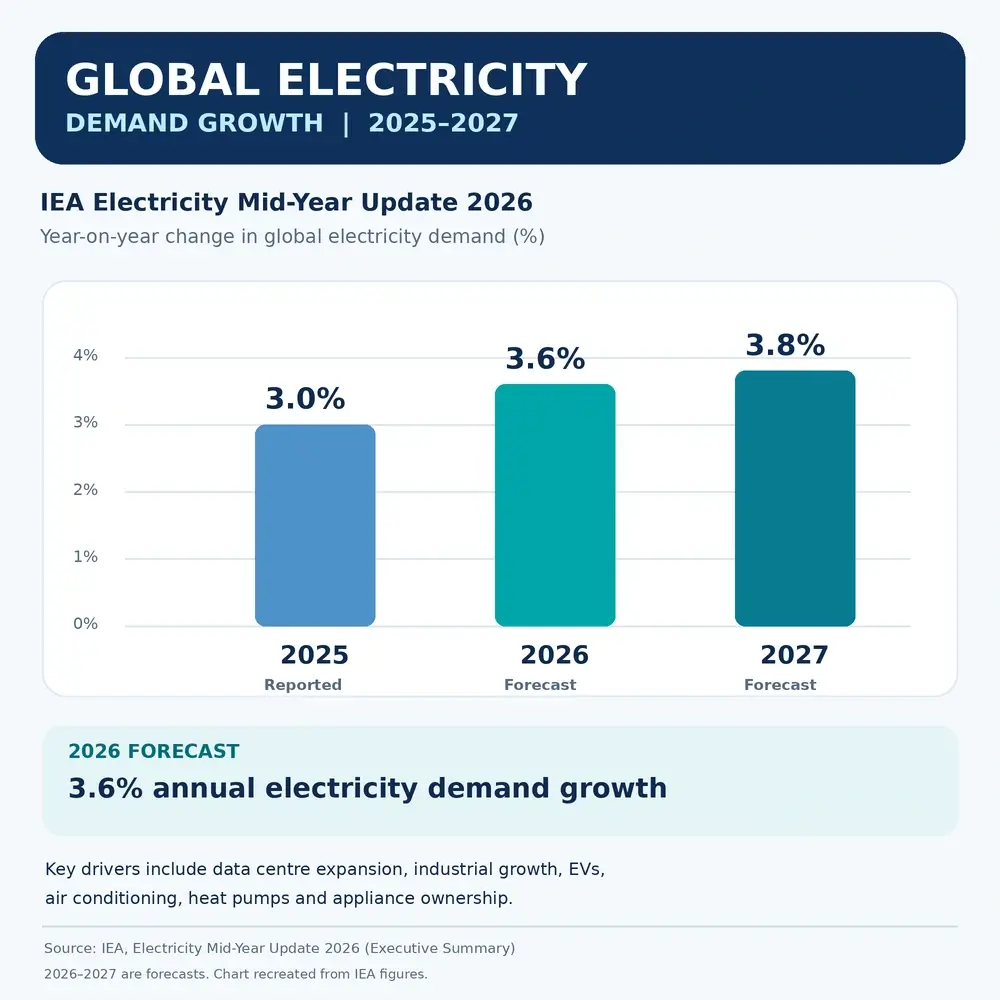
According to the International Energy Agency (IEA), global electricity demand is forecast to grow by 3.6% in 2026, compared with approximately 3% in 2025.
Data centers are among the important contributors to this growth.
Now, a new development is drawing attention to the role of flexible electricity resources.
On October 22, 2026, Google and Voltus announced an expanded agreement to develop a 1-gigawatt virtual power plant (VPP) in the PJM grid region of the United States.
The initiative builds on an initial 100 MW agreement announced in June 2026.
Instead of relying exclusively on constructing new centralized generation, the program aims to aggregate flexible electricity resources from homes and businesses.
These resources can include batteries, smart thermostats, and controllable industrial equipment.
When the grid faces peak demand, participating resources can adjust electricity consumption or provide other qualifying flexibility services.
For data center developers and energy infrastructure contractors, this represents a potentially important shift.
The next opportunity in energy infrastructure may not be only about building more power plants. It may also involve using existing electricity resources more intelligently.
And as distributed solar, battery storage, and remotely managed energy facilities expand, project developers face another practical challenge:
How can these geographically distributed assets be monitored, protected, and operated reliably?
Let’s examine the opportunities.
1. AI Data Center Energy Demand Is Changing Electricity Markets
Artificial intelligence has moved beyond software applications.
Behind every AI model, cloud platform, and digital service is physical computing infrastructure.
Modern data centers require electricity for:
- High-performance computing servers.
- AI accelerators and networking equipment.
- Data storage systems.
- Cooling and thermal management.
- Electrical distribution.
- Supporting facility infrastructure.
As demand for AI computing increases, operators may need larger electrical connections and more reliable access to generation capacity.
Unlike many conventional commercial buildings, major data centers often have substantial continuous electricity requirements.
This creates challenges for utilities, particularly in regions where electricity networks are already constrained.
What does the IEA forecast show?
The IEA’s 2026 Electricity Mid-Year Update forecasts global electricity demand growth of 3.6% in 2026 and 3.8% in 2027.
The organization identifies expanding data center capacity alongside industrial activity, transport electrification, cooling, and other structural demand drivers.
However, this does not mean AI data centers alone account for the entire 3.6% increase.
They are one important component of a much broader electricity-demand trend.
Why is this important for developers?
A planned data center may have financing, land, customers, and construction resources available.
But securing adequate grid capacity can still become a significant project constraint.
Developers must consider:
Power availability: Can the local grid supply the expected load?
Interconnection: How quickly can the facility connect?
Reliability: Can the electricity supply meet demanding uptime requirements?
Electricity costs: How will power prices affect long-term operating expenses?
Flexibility: Can certain electricity requirements be managed without compromising critical computing operations?
The final question is becoming increasingly important.
Because some of the fastest opportunities to support growing electricity demand may come from managing existing resources more effectively.
2. Google and Voltus: A 1GW Virtual Power Plant Agreement in PJM
On October 22, 2026, Google and Voltus announced a substantial expansion of their distributed energy partnership.
The companies described a plan to develop a gigawatt-scale virtual power plant across the PJM electricity market.
PJM coordinates wholesale electricity operations across parts of 13 U.S. states and Washington, D.C., serving approximately 67 million people.
How did the agreement develop?
In June 2026, Google and Voltus announced an initial three-year agreement targeting up to 100 MW of distributed capacity.
The October expansion increased the announced initiative to a gigawatt-scale portfolio.
The program is associated with a model described as Bring Your Own Capacity (BYOC).
Under this approach, a large electricity user helps finance or contract distributed flexibility that can support grid capacity requirements.
Voltus aggregates qualifying flexible resources and coordinates their participation.
Google provides funding under the agreement.
Participating residential, commercial, and industrial customers may receive economic benefits, including bill savings and payments.
Why is this significant?
Traditionally, large electricity users have focused heavily on procuring electricity from generation facilities.
The Google–Voltus arrangement illustrates another approach:
Help develop and coordinate demand-side capacity that can reduce grid stress when electricity demand is highest.
This does not mean every data center can operate entirely using virtual power plants.
It also does not mean the announced 1GW portfolio was fully installed or operating on the announcement date.
The significance is that a major technology company is supporting distributed capacity as part of its broader energy strategy.
For other data center operators, the model may provide a useful example of how to participate in grid flexibility programs while supporting regional capacity needs.

3. What Is a Virtual Power Plant?
A virtual power plant is a coordinated network of distributed energy resources.
Unlike a conventional power plant, a VPP does not necessarily consist of one physical generation facility.
Instead, software and control systems coordinate multiple resources located across different sites.
These may include:
- Residential battery storage.
- Commercial and industrial batteries.
- Rooftop solar systems.
- Smart thermostats.
- Flexible HVAC systems.
- Electric vehicle charging.
- Controllable industrial processes.
- Other approved distributed energy resources.
Depending on the market and resource capabilities, a VPP can reduce demand, shift consumption, export electricity, or provide other grid services.
How does a VPP work?
Consider an illustrative network containing several hundred commercial sites.
Some sites have battery storage.
Others have rooftop solar systems.
Additional participants have cooling equipment or industrial processes that can adjust electricity use during certain periods.
The VPP operator connects eligible resources through a central software platform.
When the grid needs flexibility, the operator sends dispatch or control signals.
Participating resources then respond according to their operating limits and contractual arrangements.
The resulting reduction in grid demand, or other qualified response, is measured and verified.
Why is the software important?
Coordinating distributed assets requires more than simply connecting them to the internet.
Operators must consider:
- Resource availability.
- Communications reliability.
- Dispatch scheduling.
- Metering and verification.
- Customer participation limits.
- Grid market rules.
- Cybersecurity.
- Payment settlement.
A virtual power plant is therefore both an energy infrastructure solution and a software coordination system.
The value comes from turning many smaller resources into an organized source of grid flexibility.

4. Why Solar + Battery Storage Is Important for VPP Development
Solar power and battery storage have complementary operating characteristics.
Solar panels generate electricity when sunlight is available.
Battery storage allows electricity to be used at a different time, subject to capacity, efficiency, and operational constraints.
For grid operators, this combination can provide flexibility that solar generation alone may not offer.
Solar generation
Distributed solar systems can reduce a building’s net electricity demand during sunny periods.
However, solar generation varies with weather, season, and time of day.
Battery storage
Batteries can charge when electricity is available and discharge when the stored energy is needed.
They may also participate in demand response and other grid services if their technical configuration and market rules permit.
Solar + storage + VPP control
A coordinated system can optimize how participating resources respond to electricity prices and grid requirements.
For example, a commercial building with solar generation and battery storage may:
- Generate electricity during daylight hours.
- Charge its battery when appropriate.
- Reduce purchases from the grid during peak-price periods.
- Discharge energy when permitted and economically beneficial.
- Participate in qualified VPP programs.
The actual financial outcome depends on electricity tariffs, market participation rules, battery degradation, operating schedules, and contract conditions.
Why does this matter for data centers?
Large data centers often require stable, high-quality electricity around the clock.
Solar and battery storage can form part of an energy strategy, but their suitability depends on facility size, critical-load requirements, and electricity market conditions.
A rooftop solar system or four-hour battery should not be assumed to provide continuous power for a hyperscale facility.
Instead, solar and distributed storage may contribute through appropriately engineered on-site energy systems, regional flexibility programs, or electricity procurement arrangements.
This distinction is important for energy developers proposing solar battery storage for data centers.
The objective is not simply to attach solar panels to data centers.
It is to determine how solar, batteries, grid power, demand response, and control systems can work together reliably and economically.

5. Demand Response: One of the Most Important Tools for Grid Flexibility
Demand response refers to changes in electricity consumption in response to prices, incentives, or grid operating requirements.
Instead of generating additional electricity during every peak-demand event, grid operators can sometimes reduce or shift consumption.
A simple example
Imagine a commercial facility normally uses 10 MW during a peak-demand period.
If it can temporarily reduce consumption to 8 MW without compromising essential operations, it may offer 2 MW of demand reduction.
For a grid operator, verified demand reductions can help reduce system stress.
For participating businesses, the arrangement may provide financial benefits.
Can AI data centers participate in demand response?
Potentially, yes.
But not every computing workload has the same flexibility.
Some tasks may be scheduled, deferred, or shifted without violating service commitments.
Other workloads require immediate processing and cannot be interrupted.
Possible flexibility opportunities include:
Workload scheduling: Running suitable computing tasks during periods when electricity is more available.
Cooling optimization: Adjusting cooling operations within approved equipment and thermal limits.
Battery dispatch: Using suitable energy storage to reduce grid imports during designated events.
Operational coordination: Integrating facility controls with utility-approved demand response programs.
These strategies must be engineered carefully.
Critical computing operations, customer commitments, equipment protection, and facility reliability should always remain priorities.
Demand response is valuable when it provides grid flexibility without creating unacceptable operational risk.

6. Virtual Power Plant Economics: Where Does the Business Value Come From?
Virtual power plants create potential economic value by coordinating resources that would otherwise operate independently.
However, a VPP is not automatically profitable.
Its business model depends on market rules, performance, resource availability, and financial arrangements.
Potential revenue and savings
Participants may benefit from:
- Demand response payments.
- Capacity-related compensation.
- Electricity bill savings.
- Peak demand reduction.
- Energy arbitrage.
- Certain ancillary-service revenues.
The available opportunities depend on local regulations, tariffs, contracts, and asset eligibility.
Major cost categories
VPP participation can also introduce costs associated with:
- Batteries and supporting equipment.
- Control systems.
- Communications.
- Software platforms.
- Metering.
- Maintenance.
- Cybersecurity.
- Asset management.
For battery participants, degradation and cycling requirements should be reflected in financial models.
Why project financing matters
Distributed energy developers need confidence that expected project revenue can support equipment investment, financing costs, and long-term operation.
Contracts, resource availability, warranty terms, and market participation requirements may materially affect project bankability.
For investors, the critical question is:
Can the distributed resource portfolio deliver measurable grid value at a cost that supports sustainable returns?
The Google–Voltus agreement suggests that large electricity users are becoming interested in helping finance this type of capacity.
But other developers must still evaluate the commercial structure of their own projects.
7. Distributed Energy Creates New Infrastructure Requirements
A utility-scale power plant typically concentrates equipment at one major facility.
Distributed energy systems create a different infrastructure challenge.
Assets may be located across numerous properties and geographic areas.
These can include:
- Commercial rooftop solar installations.
- Battery storage sites.
- Industrial energy facilities.
- Remote electrical substations.
- Utility equipment yards.
- Microgrid installations.
- Distributed generation sites.
For EPC contractors and operators, managing dispersed assets requires reliable communication, monitoring, maintenance, and site protection.
This creates opportunities for multiple types of infrastructure providers.
Electrical infrastructure
Projects require suitable switchgear, protection devices, inverters, transformers, and interconnection equipment.
Digital infrastructure
Asset operators need secure communications, metering, monitoring, control, and software integration.
Physical infrastructure
Energy installations may require fencing, controlled entrances, equipment enclosures, and maintenance access.
Security infrastructure
Site surveillance can help deter unauthorized access, document incidents, and monitor valuable equipment.
For remote solar-plus-storage locations, practical physical security planning becomes an important part of project delivery.

8. Why Security Monitoring Matters for Data Centers and Distributed Energy Sites
Data centers and energy storage facilities contain valuable electrical and communications equipment.
They also have different security requirements.
A hyperscale data center may need layered access control, permanent CCTV, secure networks, monitoring personnel, and integration with enterprise security management.
A remote solar or battery storage installation may have limited on-site staff and require dependable perimeter surveillance.
In both environments, physical security should be defined through a project-specific risk assessment.
Access control and perimeter monitoring
Security cameras can support observation of:
- Site entrances.
- Vehicle gates.
- Perimeter fencing.
- Equipment storage yards.
- Restricted operational areas.
- Maintenance access points.
Remote surveillance
At unattended facilities, appropriate outdoor cameras may support remote incident review and authorized maintenance oversight.
Construction-phase monitoring
During data center and energy infrastructure construction, permanent power and communications networks may not yet be available.
Temporary wireless surveillance can be useful for selected monitoring locations.
Security integration
For operational facilities, surveillance infrastructure may need to integrate with existing NVR, VMS, access control, and cybersecurity arrangements.
These requirements should be considered during the project design stage rather than treated as an afterthought.
As distributed energy grows, secure asset monitoring becomes part of the broader infrastructure challenge.

9. Where Solar-Powered 4G Cameras Can Support Energy Infrastructure Projects
Solar-powered 4G surveillance cameras can offer installation flexibility in locations without permanent electrical or broadband connections.
For energy EPC contractors and system integrators, this may be useful in certain project phases.
Application 1: Data center construction sites
During early construction, temporary cameras may support monitoring of equipment yards, site entrances, and material storage areas.
Solar-powered systems may be suitable for selected monitoring points where their energy reserve, recording capability, and cellular signal meet the requirements.
Application 2: Remote solar + battery facilities
Distributed energy sites may be located in areas without fixed broadband coverage.
A solar 4G camera may provide supplementary monitoring of gates, access roads, or equipment areas.
Application 3: Temporary electrical infrastructure
Utility and EPC projects sometimes require short-term surveillance of construction materials, equipment compounds, and remote work zones.
Wireless cameras can reduce the need to install temporary cabling at every monitoring point.
Application 4: Secondary perimeter coverage
At some operational sites, solar-powered cameras may supplement existing security systems.
However, they should not automatically replace permanent, continuously recording, enterprise-grade CCTV where such systems are required.
What should professional buyers evaluate?
Before selecting solar 4G cameras for energy infrastructure, consider:
- Daily power consumption and solar charging capacity.
- Battery reserve for low-sunlight conditions.
- Supported cellular frequencies.
- Environmental protection and operating temperature.
- Recording architecture and storage.
- Human and vehicle detection requirements.
- Cybersecurity and firmware maintenance.
- Integration with existing security infrastructure.
- Warranty, documentation, and supplier support.
For critical facilities, the camera system must be selected according to the project’s risk profile and operational requirements.

10. What the Google–Voltus Agreement Means for EPC Contractors and Integrators
The Google–Voltus expansion illustrates a broader trend:
Large electricity users are looking beyond conventional power procurement to consider distributed capacity and flexible demand.
For engineering companies and infrastructure suppliers, this creates several potential business opportunities.
Solar EPC contractors
Commercial solar projects may increasingly be evaluated alongside batteries and energy management systems.
BESS integrators
Distributed storage systems may benefit from new market participation opportunities, depending on location and regulatory requirements.
Energy management providers
VPP participation requires software, monitoring, dispatch coordination, and metering.
Data center developers
Flexible electricity arrangements may become one component of broader energy procurement and grid connection strategies.
Security system integrators
Construction sites, remote energy storage facilities, and distributed equipment locations may need appropriate surveillance and perimeter protection.
Not all these opportunities will develop at the same pace.
Market design, permitting, interconnection, financing, and asset eligibility will influence adoption.
However, the overall direction is clear.
Electricity flexibility is becoming a commercially important capability, not simply an optional technical feature.
11. What Should B2B Buyers Evaluate Before Investing?
If your company is entering solar-plus-storage, virtual power plant infrastructure, or remote energy monitoring, start with a structured evaluation.
Energy and project economics
Confirm electricity demand, load flexibility, storage duration, charging costs, and potential revenue sources.
Grid and regulatory requirements
Review interconnection constraints, program eligibility, dispatch rules, and performance obligations.
Equipment integration
Ensure that batteries, inverters, controls, communications, and operating systems are appropriately specified.
Operational resilience
Evaluate maintenance access, weather conditions, equipment availability, communications reliability, and emergency planning.
Site security
Determine the required camera coverage, access control, recording retention, network protections, and monitoring responsibilities.
Supplier capabilities
Choose equipment suppliers that can document product specifications, quality-control processes, certification status, customization capabilities, and long-term support.
For security importers and system integrators, understanding these requirements can help identify which surveillance products fit real infrastructure applications.
Frequently Asked Questions
Why are AI data centers increasing electricity demand?
AI workloads require substantial computing infrastructure, including processors, networking equipment, storage, and cooling. Expanding data center capacity contributes to electricity demand alongside industrial activity, transport electrification, and other growing loads.
What is a virtual power plant in 2026?
A virtual power plant coordinates distributed energy resources such as batteries, rooftop solar, smart thermostats, and flexible industrial loads to provide grid services. It is primarily a coordinated resource portfolio rather than a single physical generating station.
What is the Google–Voltus PJM agreement?
Google and Voltus expanded their distributed capacity agreement in October 2026 to target a gigawatt-scale VPP across the PJM region. The initiative builds on their June 2026 arrangement for 100 MW of flexible distributed capacity.
Can solar battery storage power AI data centers?
Solar and battery storage can contribute to suitable data center energy systems, but they are not automatically capable of providing continuous power for large facilities. System design must account for demand, storage duration, generation availability, grid connections, and reliability requirements.
What is the difference between VPP and demand response?
Demand response involves adjusting electricity consumption in response to grid needs or incentives. A VPP can coordinate demand response alongside storage, generation, and other distributed resources to deliver qualifying grid services.
Do distributed battery storage facilities need security cameras?
Physical surveillance may be appropriate where equipment, access points, or perimeters require protection. The suitable security solution depends on asset value, location, risk assessment, operational requirements, and applicable project standards.
Can solar 4G cameras be used at remote energy sites?
Yes, for suitable applications. Solar 4G cameras may support temporary or supplementary monitoring where wired electricity and communications are unavailable, provided their technical capabilities meet project requirements.
Conclusion: Flexible Energy Infrastructure Is Becoming a Strategic Opportunity
Artificial intelligence is helping accelerate electricity demand.
At the same time, new data centers and other large electricity users are creating pressure on grids already facing interconnection and capacity challenges.
The October 2026 Google–Voltus agreement demonstrates growing commercial interest in coordinated distributed resources.
Virtual power plants, battery storage, solar generation, and demand response can contribute to a more flexible electricity system.
But flexibility alone is not enough.
Successful projects also require sound financial modeling, appropriate electrical infrastructure, secure communications, reliable equipment, and effective site management.
For data center developers, EPC contractors, distributed energy companies, and security system integrators, the next solar-plus-storage opportunity may involve both building flexible energy resources and supporting the infrastructure around them.
The next phase of the energy transition will reward companies that can combine electricity flexibility with dependable engineering and operational resilience.
About SNOSECURE | Your OEM/ODM Surveillance Camera Manufacturing Partner
SNOSECURE is a professional B2B surveillance equipment manufacturer based in Shenzhen, China.
With 20 years of manufacturing experience, 6 production lines, and a 12,000m² factory, SNOSECURE supplies surveillance products to security brands, electronics importers, distributors, retailers, solar project contractors, IT hardware resellers, and system integrators.
Our product portfolio includes:
- Solar-powered security cameras.
- 4G and Wi-Fi surveillance cameras.
- AOV solar cameras.
- Solar panels and solar routers.
- NVR camera kits.
- Video doorbells.
- Baby monitors.
- Hunting cameras.
We support OEM/ODM customization, including product design, logo branding, color boxes, packaging, and application-specific product configurations.
For data center construction projects, distributed energy installations, and remote solar-plus-storage facilities, SNOSECURE‘s surveillance portfolio can help professional buyers evaluate suitable temporary monitoring and perimeter security options.
Our international markets include North America, Japan, the United Kingdom, France, the UAE, Saudi Arabia, South Africa, and other regions.
Looking for a reliable surveillance camera manufacturer for your energy infrastructure projects or wholesale distribution business?
Contact SNOSECURE to discuss solar-powered 4G cameras, OEM/ODM customization, product specifications, sample evaluation, and wholesale requirements.
SNOSECURE | Professional Surveillance Camera Manufacturer
Website: https://www.camhiprocam.com
Email: simple@camhiprocam.com
WhatsApp: +86-185-6568-6066
Contact: Simple Lee | Sales Director
Editorial Sources
Google — Google and Voltus to Build a 1-Gigawatt Virtual Power Plant, October 22, 2026.
Google — We’ve Signed a First-of-Its-Kind Agreement with Voltus, June 2, 2026.
https://blog.google/company-news/outreach-and-initiatives/sustainability/voltus-agreement/
International Energy Agency — Electricity Mid-Year Update 2026.
https://www.iea.org/reports/electricity-mid-year-update-2026/executive-summary
Energy-Storage.news — Google and Voltus Expand PJM Virtual Power Plant Agreement to 1GW, October 23, 2026.
https://www.energy-storage.news/google-and-voltus-expand-pjm-virtual-power-plant-agreement-to-1gw/
